
REVERSED DOUBLE CROSS STITCH
The Reversed Double Cross Stitch should always be worked with two contrasting colors of yarn. This stitch consists of one regular cross stitch covered by one upright cross stitch, alternating with one upright cross stitch covered by one regular cross stitch. This techniques is referred to as "overstitching". By working the two separate stitches in contrasting colors, the overstitching is easily visible and creates an exciting effect. Five diagrams have been used to demonstrate this stitch.
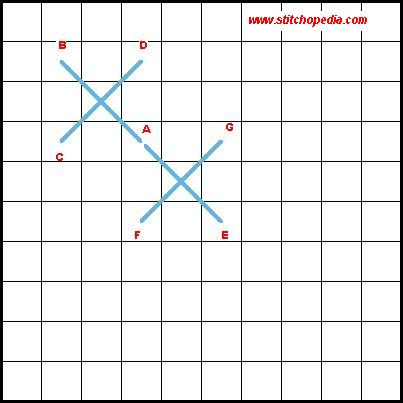


Reversed Double Cross Stitch (Diagram 1):
Bring the needle up at A, move up and to the left over two canvas intersections, bring the needle down at B. Bring the needle up at C, move up and to the right over two canvas intersections, bring the needle down at D. Bring the needle up at A, move down and to the right over two canvas intersections, bring the needle down at E. Bring the needle up at F, move up and to the right over two canvas intersections, bring the needle down at G. Now, continue on to Diagram 2...
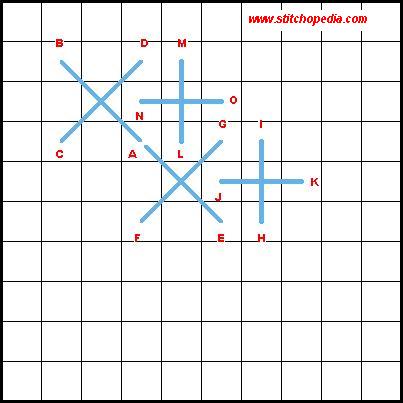
Reversed Double Cross Stitch (Diagram 2):
Beginning where we left off at G, bring the needle up at H, move up over two canvas threads, bring the needle down at I. Bring the needle up at J, move to the right over two canvas threads, bring the needle down at K. Bring the needle up at L, move up over two canvas threads, bring the needle down at M. Bring the needle up at N, move to the right over two canvas threads, bring the needle down at O. This completes the foundation part of this stitch. Now continue on to Diagram 3...
Reversed Double Cross Stitch (Diagram 3):
This is where we start the overstitching. Remember to use a contrasting color yarn for this part. Beginning where we left off at O, bring the needle up at P, move up over two canvas threads (you will be stitching over the A-E, F-G cross stitch), bring the needle down at L. Bring the needle up at Q, move to the right over two canvas threads, bring the needle down at J. Bring the needle up at R, move up over two canvas threads, bring the needle down at S. Bring the needle up at T, move to the right over two canvas threads, bring the needle down at N. Now, continue on to Diagram 4...
J
Reversed Double Cross Stitch (Diagram 4):
We will continue the overstitching here. Beginning where we left off at N, bring the needle up at D, move down and to the right over two canvas intersections, bring the needle down at G. Bring the needle up at A, move up and to the right over two canvas intersections, bring the needle down at U. Bring the needle up at G, move down and to the right over two canvas intersections, bring the needle down at V. Bring the needle up at E, move up and to the right over two canvas intersections, bring the needle down at W. This completes the overstitching part of the reversed double cross stitch. Now, continue on to Diagram 5...
Reversed Double Cross Stitch (Diagram 5):
This diagram illustrates a completed section of reversed double cross stitches. It makes an exciting pattern, doesn't it? Try using a finer yarn for the overstitching. Embroidery floss or metallic thread contrast very well with persian yarn.
 | ||||||
Stitch-opedia
An encyclopedia of needlepoint Stitches...

Copyright 2006...Stitchopedia...All Rights Reserved
*Stitch Index*
Select the first letter of the stitch you are looking for...
*Stitch Index*
Select the first letter of the stitch you are looking for...
| ||||||
